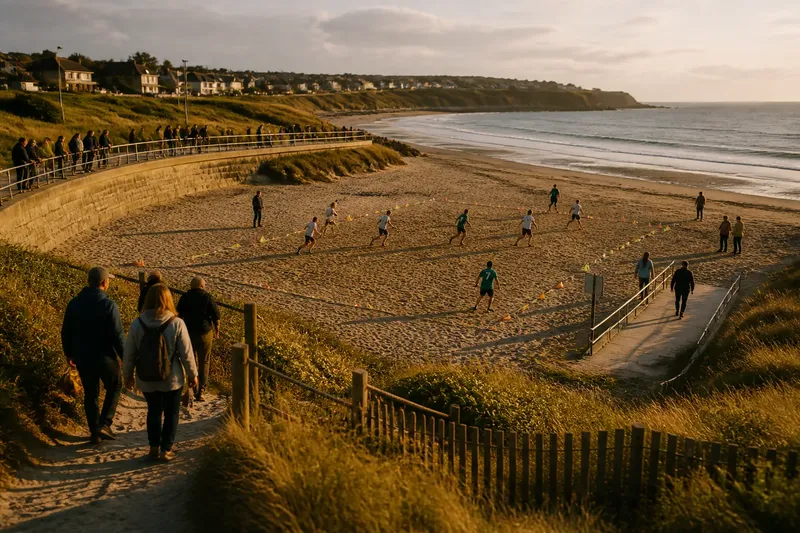
A Windy Afternoon by the Water: What to Notice from the Stands
A windy coastal match offers more to notice than the score. Read flags, roof edges and crowd sounds to distinguish local gusts from broader changes.

At a windy coastal match, a corner flag may snap while a banner under the main roof hangs slack. Watching these small changes helps you read the conditions around the ground without treating them as clues to the score. A windy coastal match is also a lesson in how stands, openings and nearby buildings shape what spectators hear and see.
What can flags reveal about a windy coastal match?
Choose a flag with open air around it and watch the cloth, not only the pole. Fabric held out in one direction suggests a steady breeze at that spot; repeated snapping and slackening suggests uneven gusts. A flag can be angled or caught on its support, so treat it as a local marker rather than a forecast.
Compare it with a second flag in another part of the ground. If both move in a similar way, conditions may be changing across more than one area. If one stays still while the other snaps, a roof, stand or wall may be sheltering it.
- Cloth stays taut: note the direction it points; if that direction remains consistent, describe a steady local breeze, otherwise keep watching before calling it a shift.
- Cloth snaps and falls slack: if the pattern repeats, describe intermittent gusts; if it happens once, treat it as a brief movement and compare another marker.
- Two flags move alike: if their positions are exposed, note a broader change as a possibility; if one is near a wall or roof, compare a third marker before drawing that conclusion.
- One flag stays still: if nearby markers move, suspect local shelter; if none move, the air may simply be calm at that moment.
- Bunting twists around its line: if it remains tangled, stop using it as a direction cue; if it hangs free, observe it alongside a flag.
- A tree branch moves while a flag does not: if the tree is exposed, record different local responses; if it is screened, rely on a marker closer to the stand.
How do the ground’s features shape the breeze?
Airflow can change over a short distance. A roof edge may guide air along a row, while a tunnel opening can make a draft noticeable in one passage. A tall stand can shelter the space behind it and leave a nearby corner exposed. The sea-facing side alone does not tell you how every section feels.
Pick fixed landmarks, such as a roof corner, entrance flag and tree beyond the boundary. Compare their movement over time. When several exposed markers shift together, a wider change is plausible; when only one does, a local obstacle or swirl may explain it.
Say you are seated beside a low wall. The far-corner flag flickers, but a flag above your stand hangs slack, and the nearby bunting barely moves. Your useful conclusion is limited: your section appears calmer than the far corner at that moment. You do not need to predict what either area will mean for play.
What can crowd sounds tell you about changing conditions?
Wind can alter how voices travel. A chant may carry across an open section and become harder to hear beneath a roof; conversation can also blur during a gust and return during a lull. The speaker’s location and the shape of the stand matter too, so listen for changes without assuming wind is the only cause.
Notice the rhythm around you: a gust may interrupt a conversation, followed by a return to ordinary chatter. If an announcement becomes difficult to hear, check whether the sound changes as you move into a sheltered concourse during a break. That comparison can help distinguish a noisy location from a passing gust.
How can you record what you observe without predicting play?
Describe visible conditions rather than assigning them a sporting effect. “The corner flag moves in short bursts” is an observation. “The wind will decide the match” is a prediction you cannot establish from the stands.
- Choose two markers: select a flag and a separate landmark, such as bunting or a tree branch; if one is obstructed, replace it with a marker in clearer air.
- Watch their movement: note whether each stays still, moves steadily or changes in bursts; if the signals conflict, record the difference rather than choosing one as correct.
- Compare their locations: check whether a roof, wall or opening could shelter either marker; if it could, describe the effect as local.
- Listen to nearby sound: notice whether voices become harder to follow at the same time; if not, keep sound and airflow as separate observations.
- Write a plain description: state what changed and where; if you cannot identify a clear change, leave the conditions as uncertain.
What questions do spectators ask about a windy coastal match?
Can a flag show the wind across the whole ground?
No single flag can represent every part of a venue because stands and walls shelter different areas. Compare markers in separate locations and describe what each one shows.
Why does the breeze seem to change near a roof?
A roof edge can redirect airflow, while a nearby opening may expose a row to air moving through the stand. Compare the spot beside the roof with an open area before deciding whether the change is local.
Why do chants sound different in open and covered stands?
Open sections let sound disperse, while a roof can reflect or contain voices. Wind, crowd noise and the position of the singer can also change what reaches your seat.
What is a useful way to describe a gust?
Say where you noticed it and what moved, such as “the entrance flag snapped twice while the roof-side banner stayed slack.” If the signs disagree, include that difference instead of claiming the whole ground changed.
What details are worth noticing on the way out?
Keep the same local focus as you leave. An exit beneath a roof may feel calmer than an open path, while a nearby flag or tree can provide another point of comparison. For a windy coastal match, that contrast is a useful reminder: conditions vary across the ground, and a careful observation describes a place and moment rather than predicting the next one.